

Secondary Dust Explosions: The Hidden Danger
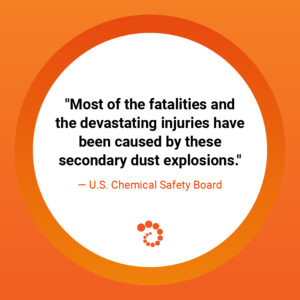
Most plants have more dust sitting around than realized. It collects on beams, cable trays, mezzanines, and the tops of equipment. You walk past it every day because nothing looks wrong, but it’s there.
A small event inside a dust collector, conveyor, or process line can shake that dust loose. Once it’s airborne, it only needs a spark. That’s when a secondary explosion hits — and that’s the one that causes the real damage.
If you’re in environmental health and safety, plant operations, or compliance, understanding secondary explosions is part of keeping your facility safe.
Why Secondary Explosions Hit Harder
A primary explosion usually stays inside equipment. It’s serious, but contained.
The real problem starts when the pressure wave moves through the building. It knocks dust off overhead beams, ledges, equipment tops, and floors, and throws it into the air. That airborne cloud now has heat and ignition energy in the same space, and the second explosion has more fuel and more room to move.
The first event creates the conditions. The second one does the damage.
Where Secondary Explosions Start
Dust That’s Been Sitting Too Long
Dust can quickly accumulate in areas that don’t get regular attention, like overheads, conduit, and equipment tops. Dust layers as thin as 1/32 of an inch can be enough to burn.
Leaks at Connectors and Transfer Points
Connections between conveyors, hoppers, and processing equipment are a common escape point. Hose‑and‑clamp connectors often leak during normal operation, letting fine particles settle on nearby surfaces over time.
Housekeeping That Stops at Eye Level
If cleaning only covers what’s easy to see, buildup continues in hard-to-reach or hidden areas. Secondary explosions feed on what gets missed.
How To Reduce Secondary Explosion Risk
This comes down to two things: keeping material contained and keeping ignition under control.
Control Dust Before It Settles
Capture dust at the source. Pay attention to transfer points and dead zones where particles hang in the air. Clean overheads and hidden surfaces on a set schedule, not just when buildup is obvious.
Seal the Source at Transfer Points
Connections are one of the weakest spots in any powder-handling system. BFM® fittings create a tight seal that keeps the product inside the process instead of letting it escape and accumulate around equipment.
What makes the difference at these points:
- A reliable seal that prevents product leakage into the facility
- A secure connection that won’t loosen during operation
- Materials that release static instead of holding it
Manage Static and Grounding
Powders build charge as they move. If that charge can’t release, you get a spark — and a spark is all a dust cloud needs.
Check grounding and bonding across equipment. Make sure there’s a clear path for charge to release, especially at connection points.
Closing the Gaps in Your Dust Hazard Analysis
Federal combustible dust standards require a Dust Hazard Analysis (DHA), but most DHAs focus on primary explosion risk and miss the secondary scenario entirely.
A stronger DHA should include:
- Dust buildup in overhead and hard-to-reach areas
- Leaks at connectors and transition points
- Grounding and bonding across equipment
- Likely ignition sources, including static
- A set schedule for inspection, cleaning, and reassessment
This isn’t theoretical. The 2008 Imperial Sugar explosion, which killed 14 workers, happened at a facility where overhead dust accumulation had gone uninspected for years.
The Next Step in Reducing Explosion Risk
Secondary‑explosion risk shows up in the places that don’t get much attention — overhead surfaces, connection points, and grounding paths. A quick walkthrough of those areas gives you a clear sense of how well your system is containing dust and controlling ignition.
For more information, see our Comprehensive Guide to Safe Powder Handling. And if you want advice about your transfer points, reach out to us.