

The Complete Guide to Connector Support Rings
Most powder processing problems at the connection point are predictable.
A connector that’s too long for its application will sag or collapse. A sleeve running under vacuum will pull inward and restrict flow. A fitting on a bulk bag filler will fold unevenly under every downstroke until the material wears through.
These aren’t edge cases. They’re common conditions — and they’re addressable before installation. Connector support rings are one of the most overlooked specifications in a BFM® fitting order, and they’re often the difference between a connector that holds up and one that fails early.
Here’s what they do, when you need them, and how to choose the right type.
What Connector Support Rings Do in Powder Processing
Support rings are stainless steel or plastic rings embedded into the walls of a BFM flexible connector. They’re fully encased inside the connector material — no ring surface ever contacts the product moving through the line.
Their function is structural: They hold the connector’s walls open when operating conditions would otherwise force them inward or allow them to deform. That pressure comes from three sources (length, vacuum, and compression) and rings address all three.
When You Need Connector Support Rings
Long Connectors
The standard threshold: if your connector is longer than 8″ (200mm), it needs rings. Space them every 4″ (100mm) along the length. For connectors around 6″ long, rings can still be added, spaced 3″ apart.
The longer a sleeve gets, the more likely its walls are to sag inward — especially if there’s any movement in the line. A sifter or oscillating piece of equipment accelerates this. Rings keep the geometry consistent across the full length of the connector.
Vacuum Applications
Under negative pressure, the vacuum pulls the connector walls inward. The standard rule: A connector running under vacuum should be no longer than its own diameter without rings. A 100mm (4″) diameter connector under vacuum should be no more than 100mm long without rings.
That rule has real operational weight. Vacuum conveying systems depend on seal integrity throughout the entire line. Any air drawn in through a collapsed or leaking connection reduces conveying efficiency and creates contamination risk. As Plastics Technology notes, vacuum systems are designed to maximize powder movement while minimizing dust exposure; a compromised flexible connection at any point undermines both.
According to BFM Global technical specifications, a 400mm long connector with three support rings spaced 100mm apart holds as much vacuum as a standard 100mm connector without rings. Without rings, that same 400mm connector will collapse under load.
Rings also work in positive-pressure applications. They resist outward expansion the same way they resist inward collapse — a longer connector under pressure is more stable with rings than without. See our vacuum application page for additional product guidance.
Compression Applications
Equipment that moves vertically (bulk bag fillers, filling heads, bag feeders) compresses the connector on the downstroke. Without rings, the sleeve material folds unevenly during compression. That uneven folding creates wear points, and those wear points become leaks.
Rings maintain the connector’s diameter during compression, so the material folds predictably and wears evenly, rather than buckling at random points along the sleeve.
Types of Connector Rings
BFM connector support rings come in two materials, and the right choice depends on your application.
Stainless Steel Rings
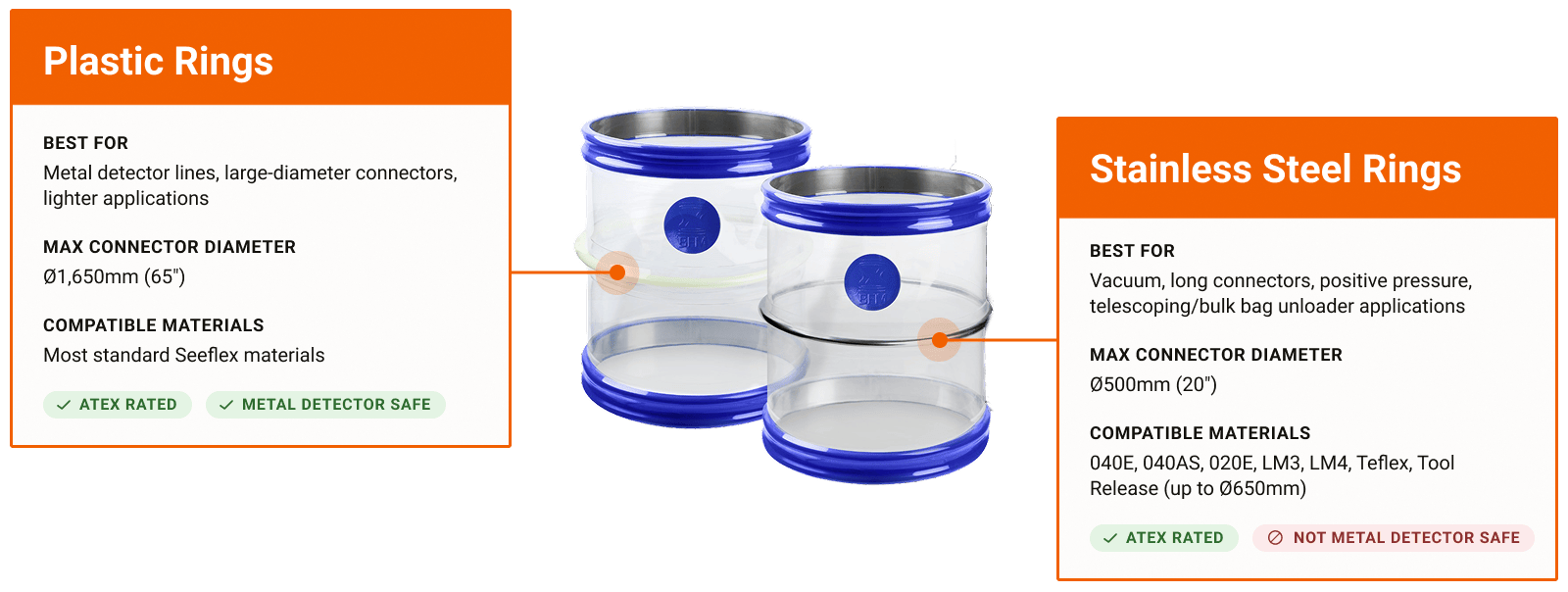
Stainless steel is the standard choice for most powder processing applications. SS rings work in connectors up to Ø500mm (20″) in diameter and provide strong resistance to both positive and negative pressure. They’re rated for ATEX-classified environments.
Common applications: vacuum conveying, long connectors, telescoping lines, bulk bag unloaders.
Plastic Rings
Plastic rings are required for connectors over Ø500mm — up to the maximum BFM connector size of Ø1,650mm (65″). They’re also the correct choice for any application where the connector passes through a metal detector, because they don’t interfere with the detector’s operation.
A practical installation note: Plastic rings have slight flex, which makes it easier to compress the connector and thread it through the metal detector opening — both when fitting it in place and when removing it for cleaning. For food and pharmaceutical lines where metal detection is standard, plastic rings are the version to spec.
Both ring types are fully encased in the connector wall — no ring material contacts the product at any point. Both are rated for use in ATEX zones.
When Rings Won’t Work
Rings can’t be used in every configuration. Tapered connectors can’t accommodate them. Seeflex 060ES and Kevlar/Blackout Cover connectors are also incompatible with ring integration.
For applications that need vacuum resistance but can’t use rings, the Flexi connector is the alternative. Flexi connectors use a continuous embedded steel coil rather than individual rings, and they maintain their diameter more consistently under compression. They’re available in diameters up to Ø300mm (12″). See the full compatibility details in our integrated rings guide.
How to Choose the Right Connector Ring Setup
The wrong ring specification isn’t always immediately obvious. An under-specified connector will perform adequately — until vacuum loads increase or a longer connector starts to sag. By then, you’re troubleshooting a failure instead of making a specification call.
Confirm these five things before ordering:
- Connector diameter: Determines whether stainless steel or plastic rings are appropriate. Over 500mm, plastic is required.
- Connector length: Sets the minimum ring count. Longer than 8″? Rings are likely needed.
- Operating pressure: Vacuum, positive, or both. Rings help in all three conditions.
- Metal detector in the line: If yes, plastic rings only, regardless of diameter.
- Sleeve material compatibility: Not all materials accept rings. Review the full list before ordering.
When to Upgrade to BFM Connector Rings
If you’re currently using a flexible connector without rings and experiencing any of the following, rings are worth evaluating:
- Product flow restrictions that don’t trace back to equipment or material changes
- Uneven wear patterns on the connector sleeve
- Connectors on oscillating equipment that need frequent replacement
- Vacuum lines where conveying efficiency has dropped without a clear cause
Rings are an add-on to an existing connector specification — the snap-in system, the spigot sizing, and the material selection stay the same. The upgrade is a specification change, not a system redesign.
Get the Right Specification Before You Order
Connector support rings are among the most commonly missed items in a BFM fitting order. Most buyers know which connector they need — fewer know whether it needs rings, which material, or how many.
We’ve configured connector ring specifications across more than 25,000 installations in food, pharmaceutical, chemical, nutritional, and industrial powder handling environments. If your application involves vacuum, long connectors, or compression — or if you’ve had a connector fail in a way that didn’t make sense at the time — it’s worth a five-minute conversation before the order goes in.
TALK TO AN EXPERT
Contact Us
Let’s get connected
Ready to discuss your unique BFM® fitting application? Contact us for a solution.
Contact Us