

NFPA 660: What Powder Processors Need to Know
If your Dust Hazard Analysis still points to NFPA 652, it is time to see what changed under NFPA 660.
NFPA 660 combines six earlier combustible-dust standards into one document, effective December 6, 2024. For your plant, that means checking whether your DHA still reflects the materials, equipment, and process conditions on your line today.
Let’s break down what changed, what to review in your DHA, and where flexible connections fit into the picture.
What Changed With NFPA 660?
NFPA 660 covers the core dust safety rules first, then adds specific requirements for each industry.
| Previous Standard | Covers |
|---|---|
| NFPA 61 | Food and agricultural processing |
| NFPA 484 | Combustible metals |
| NFPA 652 | Combustible-dust fundamentals |
| NFPA 654 | General powder and particulate handling |
| NFPA 655 | Sulfur |
| NFPA 664 | Wood processing |
This makes the standards easier to navigate for plants handling multiple materials or processes. But which rules apply still depends on your powder, your equipment, and how your process runs.
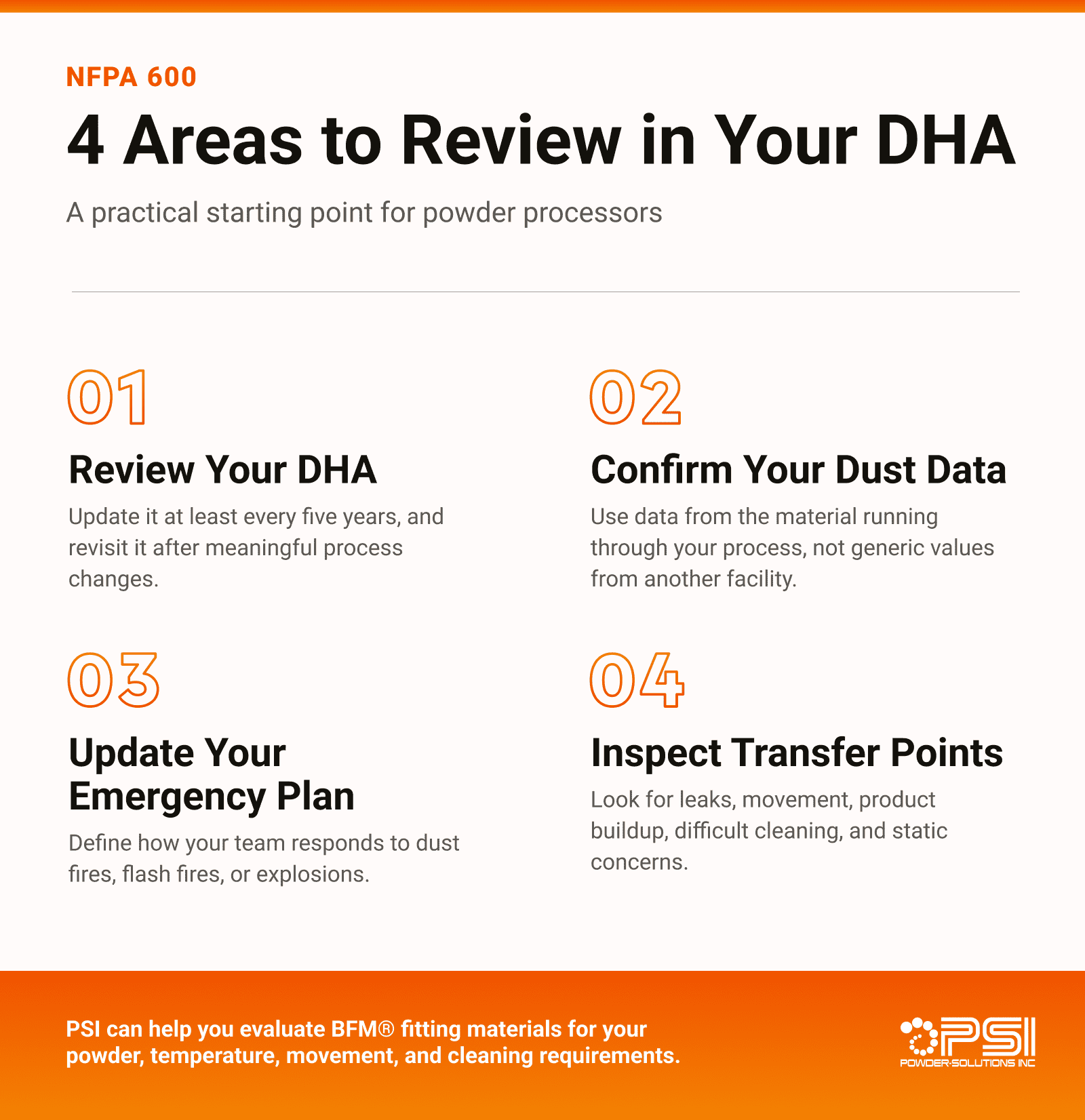
Four Areas To Review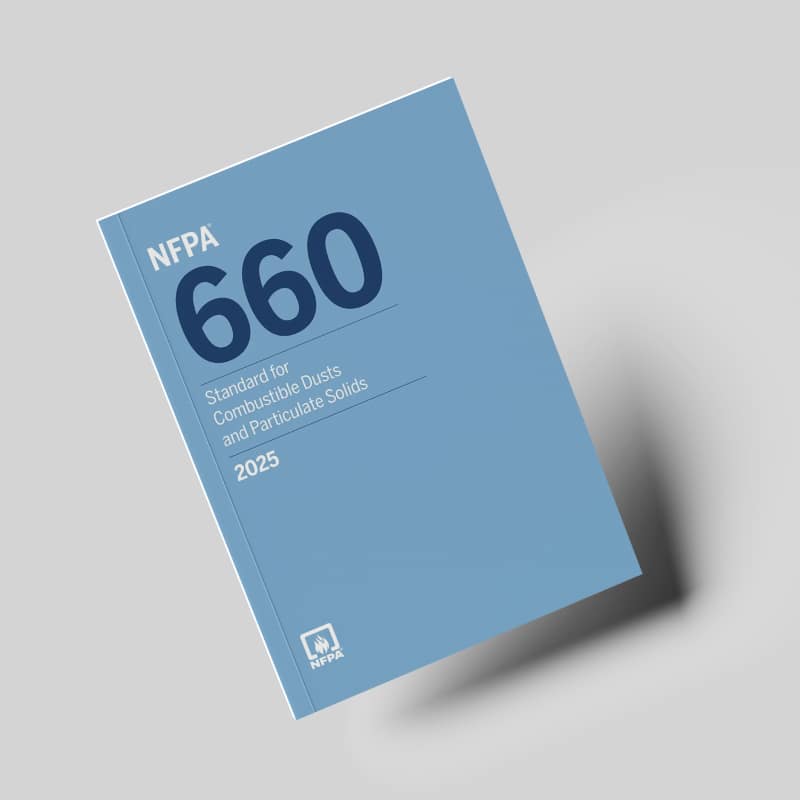
A DHA is only useful when it reflects what is happening on the line now. Start with these four areas.
1. Your Last DHA
NFPA 660 requires a DHA to be reviewed and updated at least every five years. You may need to revisit it sooner if you change materials, add equipment, alter the process, or reconfigure the line. NFPA 660’s first-draft report for the 2027 edition cycle states that a DHA must be reviewed and updated at least every five years.
A DHA that references NFPA 652 isn’t automatically unusable. Just make sure its hazard findings, action items, and controls still match up with NFPA 660 and how your operation runs today.
2. Your Dust Data
Use dust data from the material running through your equipment, not generic values from a supplier sheet or another facility’s test results.
| Test | What It Tells You |
|---|---|
| Kst | How explosive a dust cloud can be |
| Pmax | The maximum pressure an explosion can create |
| MEC | How much dust must be in the air to ignite |
| MIE | How much energy can ignite the dust |
| MIT | The temperature that can ignite dust |
These values help the DHA team understand the fire and explosion risks tied to your material.
3. Your Emergency Plan
A general evacuation plan is not enough for combustible dust.
Your plan should address:
-
What to do during a dust fire or explosion
-
Who alerts employees and calls for help
-
Where employees go
-
What employees should do and which actions could make the situation worse
-
How your team works with local emergency responders
Chapter 10 of NFPA 660 addresses emergency planning and response.
 4. Your Transfer Points
Transfer points are the connections where product moves from one piece of equipment to the next. They are also where dust leaks, product loss, and cleanup problems often start.
Look closely at connections that:
- Leak or leave visible dust
- Shift under vibration
- Collect product
- Slow down cleaning or changeovers
- Need static control
The Bottom Line for Your DHA
NFPA 660 puts dust safety rules in one framework, but your DHA still has to match how your plant runs today. Start with the connections already causing trouble: the ones that leak, shift, collect powder, or add time to every cleanup.
The BFM® fitting solution
PSI helps powder processors find BFM® fitting materials for those conditions. If you are updating your DHA or troubleshooting a transfer point, talk with the PSI team about your application and the technical documentation available for it.
Contact Us
Let’s get connected
Ready to discuss your unique BFM® fitting application? Contact us for a solution.
Contact Us